
Executive summary
As part of its work on improving the efficiency of the EU supervisory and regulatory framework and in line with the commitments set out in the EBA Report on the efficiency of the regulatory and supervisory framework, the European Banking Authority (EBA) is pursuing a holistic approach to reducing reporting costs for institutions and simplifying reporting requirements. This approach covers not only the EBA reporting framework, but also national supervisory reporting requirements and structured data collections conducted by competent authorities.
In this context, the EBA carried out a stocktake of supervisory data requests made by competent authorities to credit institutions in 2025, with the objective of increasing transparency, enhancing accountability, and improving the understanding of the scale, scope and nature of national data collections. The stocktake also collected information on simplification measures already implemented or planned by competent authorities in relation to these data requests. The exercise represents a preparatory step towards the establishment of an EU‑wide public repository of supervisory data requests, which is expected to become operational in early 2027.
The analysis shows that, in 2025, competent authorities across the EEA conducted a substantial number of structured microprudential supervisory data requests addressed to banks and their branches (671 requests of structured microprudential supervisory data totalling 978,109 requested data points). These requests covered a wide range of topics and were predominantly of a regular and recurring nature, with quarterly, annual and monthly reporting frequencies prevailing. Only a limited number of data collections were ad hoc or one‑off requests. Most data requests were used for microprudential supervisory purposes, although a significant share of the data collected was used for multiple purposes, including macroprudential supervision and statistical analysis, reflecting the increasing importance of data sharing and multipurpose use within the supervisory system.
The stocktake highlights notable differences across jurisdictions, both in terms of the number of data requests and the overall volume of requested data points. Within the SSM, banks were subject to data collections conducted at different levels, including ECB‑wide exercises, national competent authority requests and data collections initiated by Joint Supervisory Teams. The EBA reconciled information received from different sources regarding data collections in SSM jurisdictions to ensure that each request was counted only once in the analysis.
In terms of subject matter, the data requests largely focused on areas that are already well covered by the EBA reporting framework, notably credit and counterparty risk (226 data requests totalling 709,865 data points) and liquidity risk (103 data requests with 82,308 data points). At the same time, a meaningful share of requests addressed areas where limited harmonised data are currently available at EU level, such as business model analysis and certain accounting and national GAAP‑based information. This confirms both the continued reliance on supervisory data requests to complement the EBA reporting framework and the potential for further integration of national data needs into harmonised reporting.
With regard to simplification, competent authorities reported having implemented or planned simplification measures for a material subset of data collections. These measures primarily relate to the decommissioning or planned decommissioning of data requests, reductions in the number of requested data points, reductions in reporting frequency or reporting population, and the restructuring of data collections. The extent and penetration of simplification measures vary across jurisdictions, with some authorities applying simplifications to a relatively large share of their ongoing data requests. In aggregate, the reported measures are expected to lead to a meaningful reduction in the overall volume of requested data points, complementing the simplification initiatives already announced at ECB level for SSM‑wide data collections.
The overall impact of the executed or planned simplification measures in terms of the data point reduction can be estimated at 17.4% reduction of data points for the EEA national competent authorities’ data requests and at 18.5% for SSM data requests (comparing the number of the data points affected by decommissioning or data point reduction-related simplification measures compared to the amount of data points requested in 2025).
The EBA notes that the figures presented in this overview are based on modelled or defined data points and do not reflect reporting frequency, the number of institutions covered or actual reporting effort. While the EBA has made reasonable efforts to ensure consistency and quality of the information, the accuracy of the reported data remains the responsibility of the competent authorities. The overview therefore does not constitute a fully complete picture of supervisory data requests but aims primarily at providing a high‑level snapshot of current practices across the EEA. The EBA and competent authorities continue to work together on improving the quality and consistency of information as they progress with building EU‑wide public repository of supervisory data requests.
Overall, the results of the stocktake confirm the relevance of continued EBA work on transparency, coordination and simplification of supervisory data collections at EU level. The findings will inform the development of the future EU‑wide repository of data requests and support further dialogue with competent authorities on reducing duplication, enhancing data reuse and limiting the reporting burden on institutions, while safeguarding the effectiveness of supervision.
Background and introduction
- As part of its work on increasing efficiency of the supervisory and regulatory framework carried out in accordance with the EBA Report on the efficiency of the regulatory and supervisory framework[1] the EBA made a commitment to the reduce the banks’ reporting costs and to simplify the applicable reporting requirements. This commitment is of holistic nature and in addition to the simplification of the EBA reporting requirements covers also national reporting requirements and data collections by the competent and resolution authorities.
- Whilst the proposals for the simplification of the EBA reporting requirements are mostly included in the proposals for the changes to the ITS on supervisory reporting requirements, simplification of the national reporting requirements and data collections are being carried out by the respective authorities in the affected jurisdictions. The EBA in this regard aims to offer transparency on the data collections run by the authorities and the simplification actions they take in relation to these data collections. In the future such transparency and accountability will be provided through an EU-wide public repository of data requests by various authorities. The EBA is currently working on the establishment of such repository which is expected to be fully functional in early 2027.
- In preparation for the establishment of the repository and with a view of getting a better understanding of the current data requests by the competent, the EBA has carried out a stocktake of the data requests made by the authorities in 2025 and the associated simplification measures (see also Methodological notes at the end of this document).
- This note provides a high-level overview of the key outcomes of the stocktake focusing on (1) regular and ad hoc structured requests of microprudential supervisory information from banks in the course of 2025, and (2) information regarding already completed or planned simplification actions regarding those data requests.
- The information in this overview aims at providing basic overview of the additional supervisory data requests faced by the EEA banks on top of the regular supervisory reporting requirements set out in the EBA reporting framework as notified to the EBA by the competent authorities. Whilst the EBA has made reasonable efforts to ensure sufficient quality of the presented information and consistency across the jurisdictions, it cannot guarantee complete accuracy of the information. Therefore, this overview cannot be treated as a fully complete picture of the supervisory data requests. The EBA together with the competent authorities will continue to work on increasing the accuracy and consistency of the data as part of the work on building the EU repository of data requests.
- At this stage the overview does not include information regarding data requests by the resolution authorities, nor it does provide individual details on the data collections. These will be made publicly available, to the extent possible given legal and market sensitivity constraints, only through the future EU-wide repository. This coupled with the continuous work to improve the accuracy and cross-jurisdictional consistency would mean that the information on data collections (their numbers and size) published at a later stage may not necessarily correspond to the aggerate figures provided in this note.
1.Overview of the data requests by the competent authorities
- Based on the responses to the stocktake in 2025 the EEA competent authorities have made 671 requests of structured microprudential supervisory data from the EEA banks as well as their branches totalling 978,109 requested data points (modelled/defined data points).
- These data requests come on top of the harmonised EU regular reporting requirements set by the EBA and measuring 92,000 modelled data points (and 45,000 data points applicable only to small and non-complex institutions (SNCIs) and the EBA EU-wide stress testing data collection totalling 444,280 data points.
- Out of the total national data collections, 185 data requests totalling 110,787 data points were made by the competent authorities in the non-SSM jurisdictions.
- The situation is more nuanced within the SSM jurisdictions, where in addition to the horizontal data collection run by the ECB, the banks are subject to data requests by (1) national competent authorities, and (2) the joint supervisory teams (JST), where relevant. To this end, in 2025 there were:
- 46 active SSM-wide data collections totalling 533,216 data points;
- 202 data collections totalling 109,533 data points run by the SSM national competent authorities (NCAs); and
- 238 data collections (224,573 requested data points) run by the JST.
- In addition to the above data collections, institutions in many jurisdictions are subject to FINREP solo reporting both in SSM and non-SSM jurisdictions, which is not reflected in this overview as this is a part of the legal requirements imposed, for example by the ECB regulations in the case of the SSM jurisdictions.
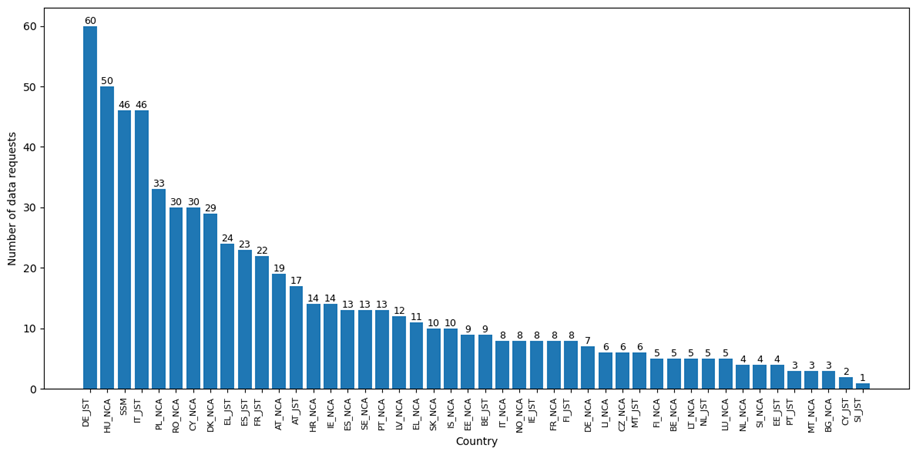
Notes: This chart shows the number of distinct data requests associated with each country. The count is based on unique Request ID values for the data collection included into the analysis. The chart reflects the individual number of requests rather than their reporting volume. This chart does not reflect the effects of the simplification measures taken in 2025 (see Section 2).
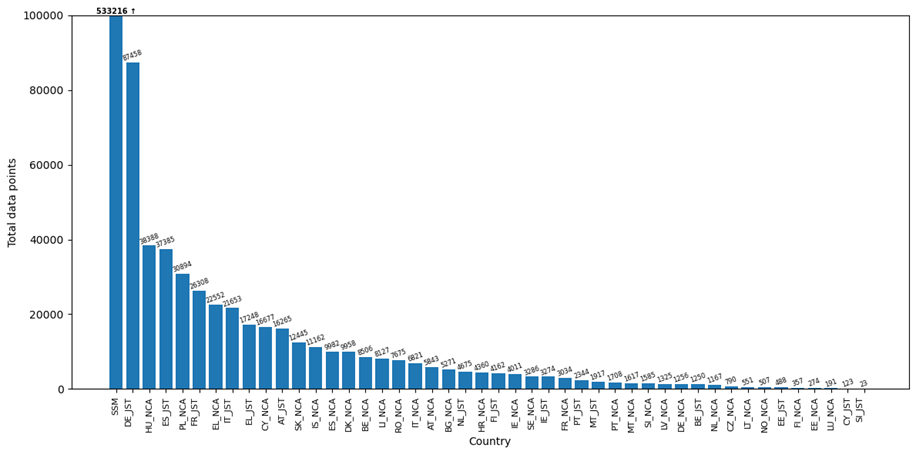
Notes: This chart shows the total number of requested data points by country. The total is calculated as the sum of open and closed quantitative and qualitative data points associated with each request included into the analysis. The chart provides an indication of reporting volume but does not account for differences in reporting frequency. This chart does not reflect the effects of the simplification measures taken in 2025 (see Section 2).
- As the focus of the stocktake was on supervisory data requests collected for microprudential purposes, naturally most of the data requests 546 (out of 671) totalling 382,341 data points were used solely for microprudential purposes. The supervisory data requests, however, may serve for different purposes and be shared amongst the authorities based on the appropriate data sharing arrangements. Such cross-sharing of data and multipurpose use of the data collection was present in relation to 125 data collections (595,768 data points) as many competent authorities have data sharing arrangements with other relevant authorities their jurisdictions for macroprudential, statistics and central banking purposes. To this end, in addition to microprudential uses, the data collected for multiple purposes was mostly used for the purposes of macroprudential supervision and statistics.

Notes: This chart shows the number of data requests grouped by country of data request and broken down by the declared categories of use of reported data. The counts are based on unique Request ID values for the requests included into the analysis. Records with missing or placeholder values in the category field are excluded. This chart does not reflect the effects of the simplification measures taken in 2025 (see Section 2).
- In terms of the main topics that have been covered by the data requests both by a number of the requests and amount of data points requests, the vast majority of the requests covered credit and counterparty (226 data requests totalling 709,865 data points), liquidity risks (103 data requests with 82,308 data points) and capital adequacy (65 requests totalling 18,687 data points) where all three are already well covered by the EBA reporting framework. The fourth most popular topic of data requests was business model analysis (51 request with 56,491 data points), where there is indeed not much information available from the EBA reporting framework.
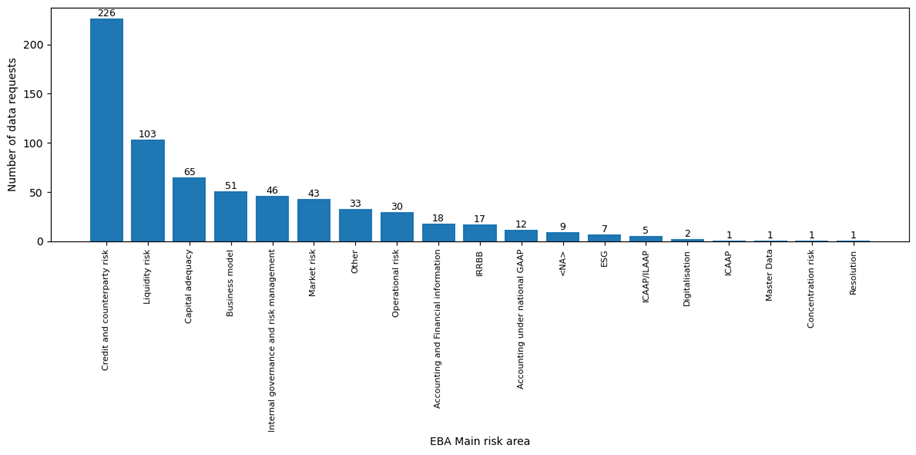
Notes: This chart shows the distribution of data requests across main risk areas associated with the data requests. Each request is counted once according to the primary risk area classification provided in the dataset. This chart does not reflect the effects of the simplification measures taken in 2025 (see Section 2).

Notes: This chart shows the total number of requested data points aggregated by main risk area associated with the data request. Data points associated with each request are attributed to the primary risk area indicated in the dataset. This chart does not reflect the effects of the simplification measures taken in 2025 (see Section 2).
- Most of the data requests made by the competent authorities were of regular and recurring nature with quarterly, annual and monthly frequencies dominating the frequency spectrum. Only 15 data requests out of the total of 675 (covering 17,890 data points) were of ad hoc one-off nature. Weekly and daily data requests amounted to 61 covering 41,581 requested data points).
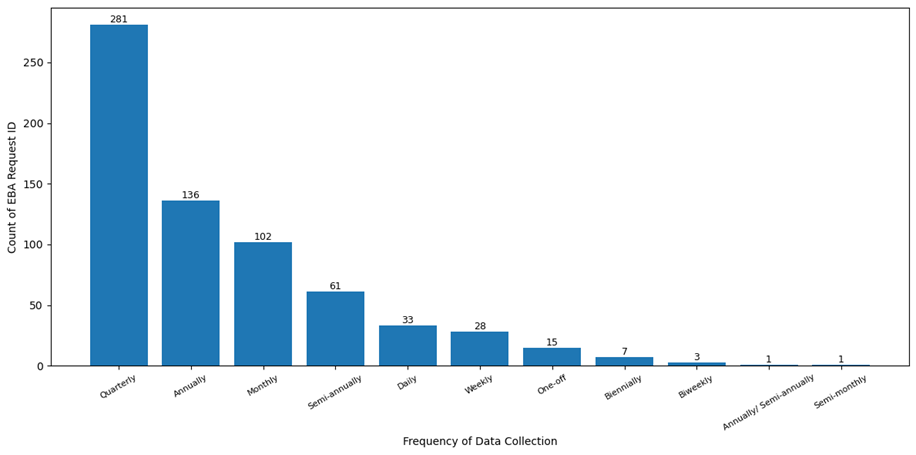
Notes: This chart shows the distribution of reporting frequencies across the analysed data requests. Each request is counted once according to its declared reporting frequency. Data request with a null value are not counted in the graph. This chart does not reflect the effects of the simplification measures taken in 2025 (see Section 2).
2.Overview of the simplification actions by the competent authorities
- Based on the responses to the stocktake the non-SSM and SSM national competent authorities have carried out or planning to implement simplification actions in relation to 98 data collections (25.3% of 387 total data requests by the NCAs). The most popular simplification measures being related to the decommissioning or reduction of the count of the requested data points and planned decommissioning and planned reduction (77 data requests with the simplification measures related to decommissioning or data point reduction leading to a total reduction of the requested data points by 38,425), reduction or planned reduction of reporting frequency (10 requests), reduction of the reporting population (7 requests), and restructuring of the data requests (3 requests)[2].
- In addition to the simplification measures already undertaken or planned for 2026, where the specific outcomes are already known and included in this analysis, many competent authorities reported additional simplification measures being discussed without any clear outcome known to date. Such potential further simplification actions are not reflected in this overview.
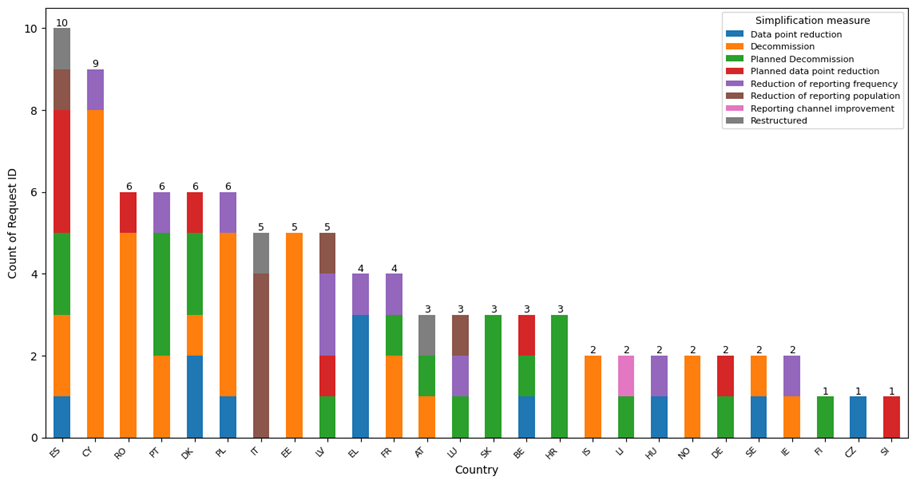
Notes: This chart shows, for each country, the number of distinct data requests associated with each type of simplification measure. The count is based on unique Request ID values within each country and simplification-measure combination. Data Request without a simplification measure are not counted in the graph. Data excluded the simplification measures carried out or planed for the SSM-wide and JST data collections that are taken into account separately.
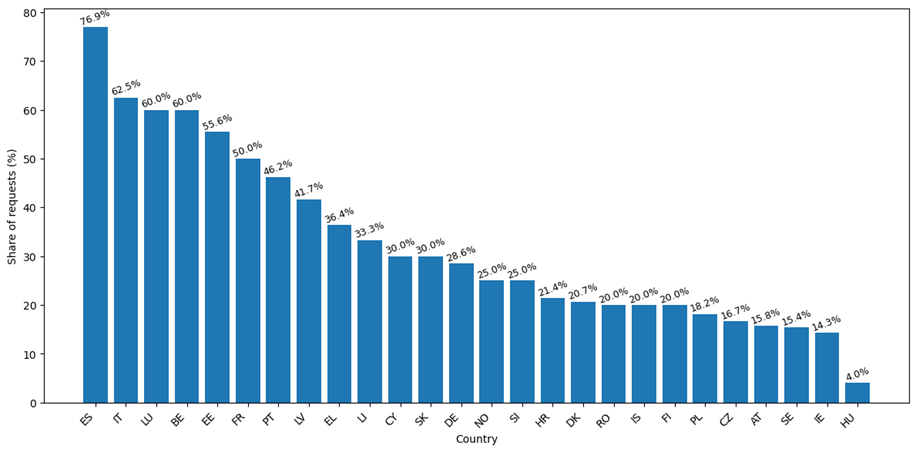
Notes: This chart shows, for each country, the proportion of data requests that are associated with at least one simplification measure. It is calculated as the number of distinct requests linked to a simplification measure divided by the total number of requests identified for that country. Data excluded the simplification measures carried out or planed for the SSM-wide and JST data collections that are taken into account separately.
- The simplification measures carried out by the national competent authorities alone in relation to their data collections lead to the overall reduction of the data points by at least 17.4% (38,425 data points to be reduced or planned to be reduced through decommissioning or data point reduction measures compared to 220,320 requested only by the CAs).
- These simplification by the competent authorities come on top of the simplification measures announced by the ECB in relation to their own horizontal ECB/SSM-wide data collections, where the impact is estimated to be at least 18.5% for the ECB 2026 short-term exercise reporting package, through which the ECB obtains the information relevant for SREP[3].
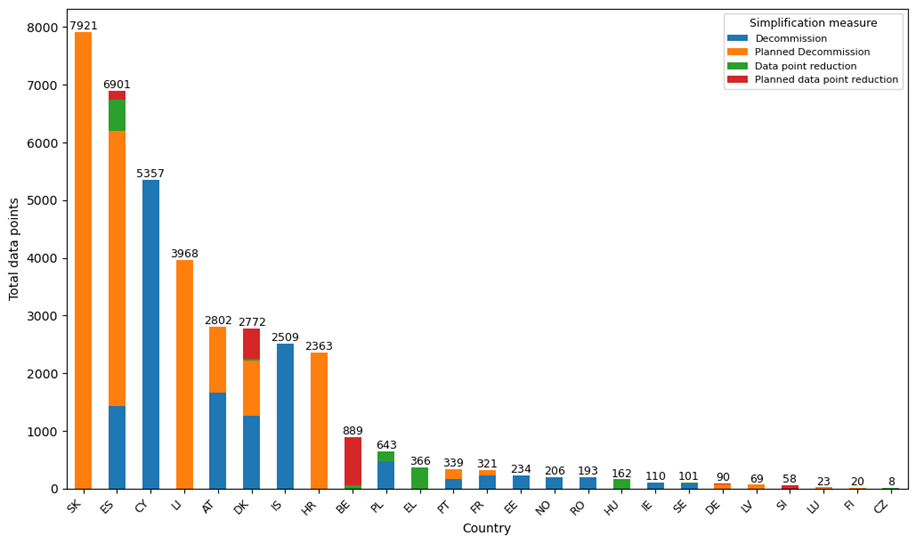
Notes: This chart shows the number of data points by country affected by simplification measures. The analysis focuses on four types of measures: decommission, planned decommission, data points reduction and planned data point reduction. Data excluded the simplification measures carried out or planed for the SSM-wide and JST data collections that are taken into account separately.
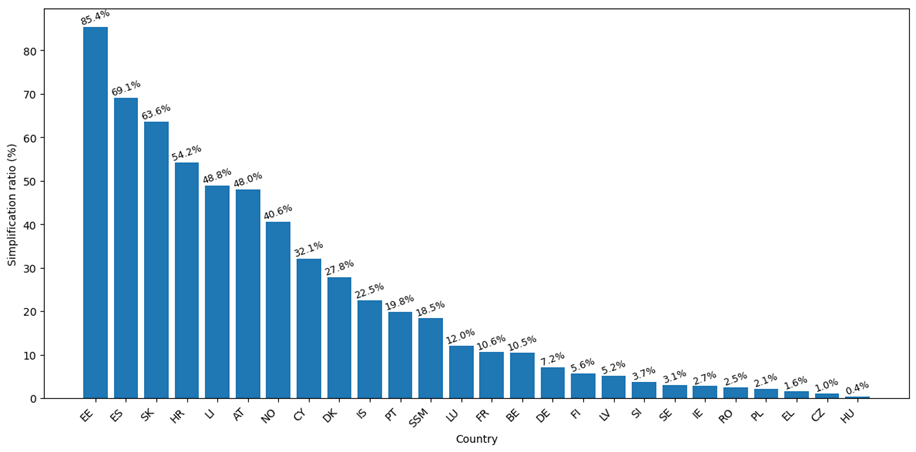
Notes: This chart shows, for each country and for the SSM, the share of requested data points by the competent authorities that are affected by simplification measures. It is calculated as the number of data points associated with the four core simplification measures (decommission, planned decommission, data points reduction and planned data point reduction) divided by the total number of requested data points identified in the stocktake.
- In addition to the simplification measures summarised above, competent authorities are planning further simplifications based on the simplifications of the EBA reporting framework proposed by the in the Consultation paper on changes to the ITS on supervisory reporting, for example FINREP solo reporting requirements imposed by the competent authorities are likely to be simplified to reflect the changes to the consolidated FINREP, equally some national liquidity-related data collection are planned to be phased out as the underlying data is going to be incorporated into the EBA reporting framework.
Methodological notes
The overview presented in the note is based on the information collected by the EBA through the stocktake responded by the EEA competent authorities. All competent authorities provided information regarding their microprudential data collections.
For the SSM jurisdictions, national competent authorities (NCAs) provided information regarding their own data collections and the ECB provided information regarding data requests addressed to significant institutions (SI) including the data requests made by the ECB directly and the SSM-NCAs. Overlapping data requests in the SSM jurisdictions reported to the EBA by the ECB and SSM-NCA have been reconciled to ensure that they appear in the analysis only once.
The stocktake is focused on national supervisory reporting and supervisory data requests that come in addition to the data reported by the institutions based on the EBA reporting framework (including EBA implementing technical standards and guidelines). The covered data requests are addressed by the authorities to credit institutions in their jurisdictions and include the data requests where the CA 'owns' or is responsible for the data requests. The stocktake therefore covers all regular/recurring data requests by the CA addressed to groups of (horizontal data collection) or individual credit institutions, and ad hoc information requests to one or more credit institutions that implies provision of data using a structured template.
The stocktake and the overview in this note includes microprudential supervisory data requests, both recurring and ad hoc affecting one or more credit institutions that took place in 2025 (January to December). The overview also includes simplification actions taken in 2025 or planned for 2026 in relation to the reported data collections. This includes also the data requests that have been initiated before 2025, but that are still valid in 2025 (data is being reported in 2025). Where the outcome of the simplification measures is not yet known, e.g. the competent authorities reported simplification measures still under the internal consideration, these measures are not included in this overview.
The stocktake and this overview does not include data requests addressed to payment institutions, e-money institutions, third-country branches or investment firms. As the focus is on microprudential supervisory data requests, the stocktake and this overview does not include data requests for the purposes of macroprudential, statistical, monetary policy, AML-CFT or consumer protection nature. Data collection for the purposes of credit registers is also not included. However, if the microprudential supervisory data requested is used for other purposes, e.g. statistical or macroprudential, such data collections are included in this overview. Data requests initiated at the request of the EBA (e.g. EU-wide stress test) are not included in this overview either.
The count of data points reflected in this overview both for the data requests and simplification measures is based on the count of the requested data points (defined or modelled data points in the date requests, i.e. empty fields in the template to be reported by institutions to the competent authorities). Open data points, and z-axis data points are counted only once as modelled data points (e.g. only as collum headers not affected by a possible number of rows that may be reported in such tables). To this end the data point count does not reflect the actual reporting by institutions in terms of (average) submitted data points nor does it consider frequency of the data requests and their scope in terms of the institution subject to a data requests. This simplification has been applied to ensure better comparability of data across the jurisdictions. This simplification and the focus on the modelled/defined data points may mean that the impact of simplification measures provided in this overview may differ from the impact of the simplification measures declared by some competent authorities elsewhere, where such impact is provided not in the terms of modelled/defined data points but, for example, as a multiplication of modelled/defined data points by frequency and number of institutions covered.
Whilst the EBA has made reasonable efforts to ensure the consistency of the reported data across jurisdictions and have shared full details of all reported data collection with all competent authorities involved for their review, the EBA is not responsible for the accuracy of the data reported by the competent authorities. Such responsibility for the accuracy of the reported data lies with the competent authorities.
[2] Excluding the simplification measures carried out or planed for the SSM-wide and JST data collections (see below).
[3] ECB report on streamlining supervision, safeguarding resilience (11 December 2025) (see: https://www.bankingsupervision.europa.eu/ecb/pub/html/ssm.streamlining_supervision202512.en.html)